Why Is My Pool Green
Written by webtechs

Pool Still Green After Shocking

Why Is My Pool Green

You’ve just shocked your pool but the water remains green. What causes this and what can you do to restore its bright blue color?

Chemical Composition Of A Clear Water Pool

Several factors go into making a pool appear clear and not cloudy. For example, pool experts suggest pH levels stay between 7.2-7.8 for everyday usage. Alkalinity is different than your pH levels, as it measures the water’s ability to resist change in pH. This makes it easier for both pH and chlorine ranges to stabilize.

If chlorine levels go unchecked for long periods of time, algae can take over. This will undoubtedly result in cloudy water. One last factor to keep in mind is calcium hardness. High calcium levels make it harder to dissolve calcium in the water. This could result in a clogged pool filter.

Why Is My Pool Still Green After Shocking It?

Whenever pool chemicals are not properly maintained, it’s easy for pH levels to get too high, ultimately leading to green water. If you have already shocked the pool and taken pH level samples, it is still possible to need to add phosphate removers or stabilizers. Stabilizers can steadily increase chlorine levels over time until the chemical is able to kill off any algae.

Phosphates will cause algae to grow in the pool and can be brought to the water through organic particles, such as bugs or leaves. Because the phosphate is fueling off the algae growth, a phosphate remover needs to be used to cut off food supply and stop the algae growth. 

Why Is My Pool Still Cloudy After Shocking It?

It is recommended to wait at least 18 hours after shocking the pool before determining the water’s clarity. If the pool water remains cloudy after a full 24 hours, you should consider adding a pool clarifier and utilizing the filter to remove any remaining settlements.

If the pool water remains cloudy, adding a clarifier is the best way to evaluate the pool’s filter and ensure it does not need to be replaced or that the filtration system needs maintenance.

How Much Shock Should I Add To The Pool?

Shocking a pool is essentially adding chlorine to make the pool water “super chlorinated.” For most residential pools, 10 gallons of liquid chlorine or 5 pounds of granular chlorine should be used to shock the pool. Check your manufacturer instructions to see if liquid or granular chlorine works best with your specific filter.

How Long Should I Use The Pump For?

Pool filters should be run continuously for 24 hours after shocking the pool to remove cloudiness. Since algae grows faster in warmer weather, a pump will need to run longer during summer months and shorter during winter months. Pool water should always be filtered, regardless of season.

The turnover rate is a measurement of how long it takes for the circulation system to move all the water through the filter equipment. These can be impacted by the pool size, as well as the gallons per minute rating of your pool’s pump. 

Pool Service Gilbert In Arizona

Pool Service Gilbert is a family-owned and operated business that has been serving the valley since 2004. We offer reliable and affordable pool services, including repairs, equipment installations and more! Our service area includes Ahwatukee, Chandler, Gilbert, Mesa, Phoenix and Tempe, Arizona. Contact us right here for your upcoming pool service needs.

More Articles About Pool Care

How To Lower pH In Pool
Written by webtechs

How To Lower pH In Pool

How To Lower pH In Pool

Every pool owner should want pH levels to remain in the range of 7.4-7.8. What can you do to lower the pH level if it becomes too high? Use our DIY guide below!

Effects Of High pH Levels

So why is a high water pH level or pH above 7.8 bad for a swimming pool? Here are a few issues that you may have to deal with if your pH is too high:

  • The water can sting your eyes and cause dry skin.
  • Pool water can become hazy or cloudy.
  • Chlorine will become less effective at higher pH levels, with low chlorine promoting bacteria growth.
  • Alkalinity makes the water hard, which can cause formation from calcium deposits.

How To Lower pH Levels

Test your water before performing any DIY pool care tasks. Start by using a pool kit to determine the pH, acid demand, plus total alkalinity. Once you have determined that the pH level is too high, you can begin working to restore balance. There are two products designed specifically to lower pH: sodium bisulfate and muriatic acid. Follow our guide below.

1. Use Sodium Bisulfate

  • Read the manufacturer’s instructions, then measure the correct amount based upon your initial testing of the water.
  • Some experts suggest adding 3/4 of what is recommended, allowing for easier correction.
  • Since sodium bisulfate typically comes in powder form, avoid using this on a windy day.
  • Add the chemical by getting down to the water as close as you possibly can.
  • Apply it over the water return jet site to facilitate spreading the chemical throughout the pool.
  • This powder should dissolve within 10-15 minutes.
  • Wait at least 6 hours before retesting, yet make sure to do the test within 24 hours.

2. Apply Muriatic Acid

  • Applying this powerful corrosive means you should wear protective gear, including gloves and goggles.
  • Read the instructions first and apply the recommended amount.
  • There are two different ways to apply the acid to your pool.
  • One way involves turning the pump off, then slowly pouring the acid into the deep end.
  • Next, allow the acid to settle at the bottom, then turn the pump back on for circulation.
  • The other way involves pouring the acid over the return jets, allowing the pump to do its work.
  • Retest the water after 6 hours, but again, do not wait more than 24 hours to test.

Restoring The Water Balance

Knowing when and how to lower pH levels is a crucial skill for every pool owner to have. Don’t be afraid to contact a professional pool service to lower the pH level in your water.

Pool Service Gilbert In Arizona

Pool Service Gilbert is a family-owned and operated business that has been serving the valley since 2004. We offer reliable and affordable pool services, including repairs, equipment installations and more! Our service area includes Ahwatukee, Chandler, Gilbert, Mesa, Phoenix and Tempe, Arizona. Contact us right here for your upcoming pool service needs.

More Articles About Pool Care

Sump pump replacement cost
Written by webtechs

How Much Does It Cost to Replace a Sump Pump?

Sump pump replacement cost
Costs, on average, to replace your sump pump is $300 to $750, although it can range anyplace from $110 to $1,000. The cost basically is subject to the cost of the unit and the company you hire to replace it.

How Much Does Replacing a Sump Pump Cost?

A sump pump replacement is going to cost less than a new installation, at around $300 to $750. On the average, you are going to pay $500. Since the process to replace it isn’t as time-consuming or labor-intensive as a new installation. There’s no digging needed; you just have to take the old pump out and then install the new one.

How Do I Know When It’s Time for a Replacement?

When the motor is failing and/or your pump is over ten years old, it’s time to replace it. If you’ve noticed that your pump is constantly running or cycling on and off, these could also be an indication that your sump pump is going bad.

Sump Pump Replacement Cost Explanation

If your sump pump is failing, it’s time to purchase a new one—but going over budget clearly is not what you want. It can be beneficial to acquaint yourself with the various aspects that impact replacement costs, so you’ll know what you’re going to expect.

Costs for Labor

Professionals typically bill $45 to $200 each hour for the installation of a sump pump. Replacements only take about an hour or so (conversely, new installs can take up to 2 to 4 hours).

Type of Pump

Pedestal pumps are around $60 – $170. Submersible pumps are around $100 – $400. Submersible pumps are more costly but have more powerful. You can assume to pay more for submersible pumps repairs.

How to Save Money on Your Sump Pump Replacement

The best thing you could do to save you money on a replacement is to thoroughly examine and maintain your sump pump during the year. That way, your pump is going to last as long as it can. It’s particularly important to guarantee your pump is in good working order throughout storm seasons, prior to predicted heavy rainfall, and prior to the snow melting. Here are some routine maintenance tips for taking care of your sump pump:

  • Verify the pump’s position. Fluctuations can cause a sump pump to shift positions, so you should routinely check to make sure that your pump is sitting in the correct position.
  • Test the pump. Pour water into the pit to verify that your pump is running correctly. Do this multiple times over a year.
  • Clean the pump. Remove any debris and verify to be sure the inlet screen (located near the pump’s bottom) isn’t blocked. Do this every 3 to 4 months.
  • Acquire a filter. The filter is going to help keep things out of the pump, increasing its lifespan. Utilizing a piece of screen is a simple solution for keeping debris from getting inside the pit.
  • Hire a professional. Think about hiring a pump professional in your area to perform a yearly maintenance checkup. The contractor is going to check to be sure that the pump empties properly and that the float is working correctly.


Pool Light Replacement In Gilbert, AZ

Pool Service Gilbert is a family-owned and operated business that has been serving the valley since 2004. We offer reliable and affordable pool services, including repairs, replacement, equipment installations and more! Our service area includes Ahwatukee, Chandler, Gilbert, Mesa, Phoenix and Tempe, Arizona. Contact us right here for your upcoming pool service needs! Call us at 480-748-3022 for more information.

Standard Inground Pool Sizes
Written by webtechs

Standard Inground Pool Sizes

Standard Inground Pool Sizes

The typical length-to-width ratio is 2-to-1 for a rectangular inground pool. The most common sizes for these pools are as follows:

  • 16′ x 32′
  • 15′ x 36′
  • 20′ x 40′

Differently shaped pools, such as square or round, tend to come in smaller sizes.

Common Inground Pool Dimensions

Inground pools can come in many shapes and sizes, limited only by your budget and the size of your backyard. It’s helpful for any prospective pool owner to take a look at the standard shapes and sizes as a starting point. After looking at the many options, you’ll have the freedom to choose from the normal sizing or a more customized pool for your yard.

Inground Pool Depth Options 

Depth is the one dimension that is not limited by your property, meaning your options here are nearly endless. Much of this will depend on how the pool will be used. Typical rectangular pools measure 3-feet deep in the shallow end and 6-feet deep in the deep end. If you intend on using the pool to swim laps, the recommended depth is between 4-5 feet.

Square and round pools have a uniform depth, which is usually on the deeper end of the spectrum. Square pools continue to rise in popularity. These pools are compact, yet not very deep, on average. 

Inground Pool Vs Above Ground Pool

If you are unsure how you are going to use your pool just yet, below are a couple pros and cons of each style to help you choose.

Above Ground Pool Pros

Above ground pools are inexpensive. You can purchase them for a couple thousand dollars, and the purchase typically includes installation by a professional.

When the pool gets to your house, the installer can have it set up and ready to go that day. Bear in mind, subject to where you purchased your above ground pool, you might be left to follow the directions and put the pool together on your own. This might be a bit challenging and take a little longer.

Either way, you are going to be able to begin swimming soon after getting your pool. You can also disassemble an above ground pool (in many cases) and take it with you if you ever choose to move. Meaning you won’t end up forfeiting your investment by having to leave it behind.

Inground Pool Pros

An inground pool provides you with much more artistic control over its shape, its depth, and its general design. You are able to design your pool with curves or angles, and you are able to make it a lot more deep than above ground pools. You are also able embellish the pool decking, in which is going to add value to your home.

Additionally, they last a lot longer. The lifespan of your pool is going to depend on the materials used, but you can usually keep swimming in them for upwards of 20 years.

Pool Service Phoenix

Pool Service Gilbert is a family-owned and operated business that has been serving the valley since 2004. We offer reliable and affordable pool services, including repairs, equipment installations and more! Our service area includes Ahwatukee, Chandler, Gilbert, Mesa, Phoenix and Tempe, Arizona. Contact us right here for your upcoming pool service needs.

More Articles About Pool Care

Pool Light Replacement Cost
Written by webtechs

Pool Light Replacement Cost 2022

Pool Light Replacement Cost

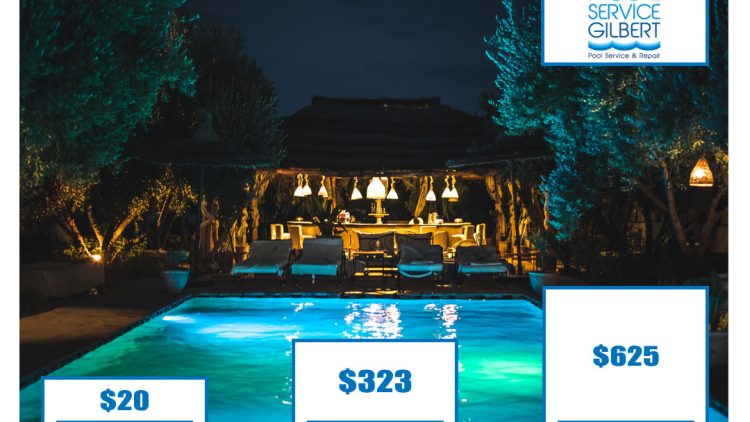
The average pool light replacement cost $625. Pool light repairs prices are a lot more budget friendly at $65 to $150 eachSimply replacing the bulbs is $20 to $100 for each one subject to type and function. Colorful LED bulbs are most costly but last longer than other types of bulbs. If you’re thinking about getting an inground pool, you are most likely also considering installing underwater pool lighting. Because we work with a lot of homeowners throughout Gilbert, Arizona and surrounding areas each year, we have the chance to answer a lot of questions concerning pool lighting. In this post, it is going to cover some common inground pool lighting questions that we receive day to day.

What should I know about pool lights?

Lighting your pool allows you to swim at nighttime with single or multi-colored ambient light. LED pool lighting enables you to change colors with ease, possibly with your smart phone. In-pool lighting is required to be installed during the pools construction. Small LED lights cost around $700–$900 installed, and fiber optics cost about $1,300–$1,700. The only necessary maintenance is bulb replacement.

Why should I light my pool?

First and foremost, lighting your pool is going to allow you to fully take advantage of your pool throughout day and night. A lot of people find nighttime swimming soothing and relaxing, but it’s just not the same without the ambiance of reflective light that underwater lights provide. Lighting your inground pool also gives homeowners peace of mind when overseeing children swim at night because adds improved visibility throughout the whole pool.

Are pool lights required to be installed during construction, or can I add them later?

Many pool accessories can be added at a later date, but pool lights don’t offer that versatility…not without significant renovation work. It is recommended if you’re in the slightest considering light your pool, it’s best to have it installed during the pool’s construction.

 How many lights am I going to need?

It subject to the type of light, it is suggested that one light, at the minimum, is going to adequately light up a pool up to thirty foot long. Pools longer than thirty feet are going to require two lights. Take heed that this is the smallest amount, most people end up getting two lights installed, and some even require to install three lights on larger pools. As of this post, full sized LED pool lights, like those that are usually installed in vinyl lined or concrete pools, typically cost between $1,000 and $1,500 installed.

  • Smaller LED lights usually cost between $700 and $900 installed.
  • Fiber optic pool lighting is typically around $1,300 to $1,700 installed.
  • Full sized incandescent pool lighting is usually around $450 to $650.

 What is the required maintenance?

The only maintenance required for any pool light is replacing the bulb. Regardless of the kind of light, you should never have the need to lower the pool’s water level for replacing the bulb. In many cases, it is simply loosening a single screw, pulling the bulb housing out of the water and replacing the bulb. The replacing only takes 5 to 10 minutes. Other types of lights, nevertheless, require that the entire housing be replaced, in which takes more time but still not a huge undertaking, especially bearing in mind the average bulb lasts for years and years. Replacing fiber optic bulbs is very easy as you just remove the box cover, located on or close to the patio, and put in a new bulb. Bulb replacement prices at the time of this post are as follows:

  • Larger LED $450 to $650
  • Smaller LED $50 to $350 subject to the model
  • Fiber optics $20 to $60
  • Incandescents $30 to $70

 Are pool lights safe?

Short answer, absolutely, they are extremely safe, so long as they are installed in accordance to manufacturer’s specifications and local building code compliant. Today’s pool lights, correctly installed, are basically risk free.

Pool Light Replacement In Gilbert, AZ

Pool Service Gilbert is a family-owned and operated business that has been serving the valley since 2004. We offer reliable and affordable pool services, including repairs, replacement, equipment installations and more! Our service area includes Ahwatukee, Chandler, Gilbert, Mesa, Phoenix and Tempe, Arizona. Contact us right here for your upcoming pool service needs! Call us at 480-748-3022 for more information.

HOW MUCH DOES A POOL COST IN ARIZONA?
Written by webtechs

Average Pool Cost In Arizona 2022

The average price to install an inground pool in Arizona is $20,656 in 2022. Costs will range from $10,863-$31,241 in Phoenix, AZ, according to Homeadvisor.

However, there are several different factors that could influence overall costs.

How Much Does A Pool Cost?

Inground pools will generally cost more to install than an above-ground pool. Above-ground models will cost anywhere from $700-$3,600. Custom pools will, of course, cost more than any other models, with prices going upwards of $100,000. Always compare quotes from local pool suppliers to receive the best deal possible.

Pool Cost Factors

The first factor that could inflate the bottom line is exactly how much it will cost for construction of the pool area. That very much depends on the type of material the installers are working with. For instance, fiberglass will cost between $20,000-$37,000, while concrete construction costs anywhere from $35,000-$65,000.

Building an above-ground pool can be considerably cheaper than an inground model. The building of the above-ground pool will run between $1,500-$15,000. The above ground pools will not add the same value to your home as an inground pool will, though. Plus most homeowners prefer the look of inground pools.

Perhaps you are still thinking about whether you should invest in a lap or endless pool. With labor costs, lap pools run between $40,000-$60,000. Endless pools tend to be much shorter than lap pools, and cost approximately $23,000-$40,000.

Inground Pool Costs In Arizona

Total costs for inground pools will very much depend on materials used for construction. These are typical prices based on material:

  • Concrete: $50,000-$100,000
  • Vinyl Liner: $25,000-$65,000
  • Fiberglass: $40,000-$85,000

Saltwater Vs Chlorine Pool Costs

Saltwater pools come with heavy upfront costs, including the installation of a saltwater generator. This costs between $400-$1,800. Installation fees could tack on an additional $400. Yearly salt and chemical costs could total $100. Meanwhile, chlorine pools could require up to $800 per year in chemical costs.

Pool Costs By Location

Are you looking to compare pool costs in Phoenix, Arizona to other big cities in the country? Here are a few average costs:

  • Miami, Florida: $17,550-$38,600
  • Dallas, Texas: $12,000-$28,200
  • New York, New York: $17,000-$33,700
  • San Diego, California: $15,300-$36,900
  • Las Vegas, Nevada: $22,300-$135,000

All average costs are according to Home Advisor.

How Much Does A Pool Cleaning Service Cost?

The average pool service costs in the Phoenix, AZ area range from $85 to $125 per month. Typically, any pool owner can expect to pay around $105 per month for cleaning services. Use this post to help determine a budget for any upcoming pool services you may need in the future.

How Much Does Pool Service Cost in Phoenix Arizona

Pool Service Phoenix

Pool Service Gilbert is a family-owned and operated business that has been serving the valley since 2004. We offer reliable and affordable pool services, including repairs, equipment installations and more! Our service area includes Ahwatukee, Chandler, Gilbert, Mesa, Phoenix and Tempe, Arizona. Contact us right here for your upcoming pool service needs.

More Articles About Pool Care

How Long To Run Pool Pump In Summer
Written by webtechs

How Long To Run Pool Pump In Summer

How Long To Run Pool Pump In Summer

Typically, pool owners should run their pool pumps 6-8 hours per day during the winter and 10-12 hours per day during the summer.

How Long To Run Pool Pump On Average

A pool pump is one of the most essential parts of a pool’s circulation system. The pump will help filter dirt, debris and produce chlorine, at the same time. It’s crucial to know how to best utilize your pump and filter during the different seasons. Changes in weather can ultimately affect how you maintain these tools.

For example, it’s best to run your pool pump between 10-12 hours during the summertime. You must run the pump for a longer amount of time during the summer because more algae will grow in warm temperatures. Longer run time for the pump will help filter out algae, which can lead to build up of debris and bacteria in your pool.

How To Calculate Pool Pump Run Time

Every swimming pool is unique, whether it’s inground or above ground. To calculate how long to run the pump, you need to factor in the type of pool, size, how often the pool is used and how much debris the pool typically collects.

Calculate the exact run time by knowing your pool’s volume (length x width x depth). Most swimming pools are between 40,000-100,000 liters in volume. Once the volume capacity has been figured out, compare it to the pump output and calculate the minimum number of hours the pump needs to be run. For instance, a 60,000 liter pool with a pump running at 200 liters per minute needs to run for at least 5 hours time.

Professionals recommend running your pump for at least one turnover every 24 hours. It is not a bad idea to have two turnovers during summertime to preserve the pool’s water quality.

When To Run Your Pool Pump

The best time to run your swimming pool pump is during the hottest hour of each day. Be mindful that this will also mean you’ll have higher energy consumption, leading to an increased electric bill.

If you wish to save on energy costs, the best idea would be to run the pump during night hours. It is okay to run your pool pump overnight while the pool is not being used.

Conclusion

Running the pool pump is necessary, but it isn’t the only way to keep up with maintenance of the water. Using other equipment, such as a pool cover or vacuum, will also help keep out debris and dirt. The pool filter should be cleaned once or twice per week. 

Pool Care In Gilbert, AZ

Pool Service Gilbert is a family-owned and operated business that has been serving the valley since 2004. We offer reliable and affordable pool services, including repairs, replacement, equipment installations and more! Our service area includes Ahwatukee, Chandler, Gilbert, Mesa, Phoenix and Tempe, Arizona. Contact us right here for your upcoming pool service needs! Call us at 480-748-3022 for more information.

Cost To Retile Pool
Written by webtechs

Cost To Retile Pool

Cost To Retile Pool

An in-ground pool tile replacement typically costs between $2,500-$5,000.

Pool Tile Replacement Cost

A pool tile replacement involves replacing the individuals tiles as well as any coping stones in a pool. A homeowner should expect to pay an average of $3,750 for a full pool tile replacement.

The exact pool tile replacement cost will very much depend on type of tile desired and size of the pool. The standard cost to retile a pool is $25 per square foot. Generally, the overall cost will come with an additional $150 per skimmer.

When Is It Time To Replace Pool Tiles?

Here are the main reasons why homeowners choose to replace their pool tiles:

  • When tiles begin falling off pool walls.
  • Pool tiles are noticeably chipped or cracked.
  • The pool tiles are discolored.
  • The pool tiles feature white deposits that cannot be acid washed.

Pool Tile Replacement Options

In addition to standard blue tiles, there are many different pool tile replacement options. Some pool tile options include:

  • Stone pool tile.
  • Ceramic pool tile.
  • Glass pool tile.
  • Porcelain pool tile.
  • Handmade pool tile.
  • Glazed pool tile.
  • Mural pool tile.
  • Custom pool tile.

Pool Care In Gilbert, AZ

Pool Service Gilbert is a family-owned and operated business that has been serving the valley since 2004. We offer reliable and affordable pool services, including repairs, replacement, equipment installations and more! Our service area includes Ahwatukee, Chandler, Gilbert, Mesa, Phoenix and Tempe, Arizona. Contact us right here for your upcoming pool service needs! Call us at 480-748-3022 for more information.

What Chemicals Do I Need For My Pool
Written by webtechs

What Chemicals Do I Need For My Pool?

What Chemicals Do I Need For My Pool

Here is a quick overview of what chemicals you should use to treat your pool. 

What Are The Main Pool Chemicals?

  • Chlorine
  • Shock
  • Cyanuric Acid
  • Bromine
  • Algaecide
  • Clarifier
  • Calcium Chloride 
  • Flocculant 

Chlorine

The most popular of all pool chemicals, chlorine keeps your pool water free of algae and bacteria. Chlorine can be purchased in many forms, including powder, liquid and tablet. When the pool water reacts with chlorine, hydrochloric acid is formed. This is the compound that ultimately fights bacteria. 

Shock

To shock a pool means oxidizing the inactive chlorine. When this is added to the water, whatever chemical is used will start a process known as super chlorination. Shocking the pool water helps kill any present bacteria and sanitizer byproducts, alike. Depending on how much you use the pool, shock should be applied once every week to two weeks. 

Cyanuric Acid

Cyanuric acid slows the sun from decomposing the chlorine in the pool water. However, there is a limited amount of cyanuric acid that can be added to the pool. Be sure to check if your chlorine includes cyanuric acid. If this is the case, it will not be necessary to add any more acid to the water. Water balance will be achieved at a neutral level of 7.0. 

Bromine

Bromine is an alternative to chlorine that is usually used to treat warmer water found in hot tubs. Bromine works better at a higher pH level, typically seen in hot tub water. 

Algaecide

Typically copper-based, these polymers are added as a preventative barrier against algae. Algaecide should be added right after the pool water has been shocked. 

Clarifier

These polymers coagulate particles in the water. Clarifier works by trapping particles in the filter. This agent can contain numerous chemicals, including enzymes, crab shell extracts and ammonium chloride. 

Calcium Chloride

A pool will need to reach a minimum level of calcium hardness before molecules look elsewhere for minerals. Calcium chloride is applied to increase calcium hardness overall. 

Flocculant

Flocculant is similar to clarifier since it binds particles together. Yet, instead of running particles through a filter, flocculant will sink the particles to the pool floor. While the flocculant is at work, pool filters need to be shut off for 8-12 hours. Vacuum the particles from the floor once the process has been completed. 

Pool Care In Gilbert, AZ

Pool Service Gilbert is a family-owned and operated business that has been serving the valley since 2004. We offer reliable and affordable pool services, including repairs, replacement, equipment installations and more! Our service area includes Ahwatukee, Chandler, Gilbert, Mesa, Phoenix and Tempe, Arizona. Contact us right here for your upcoming pool service needs! Call us at 480-748-3022 for more information.

Pool Acid Wash Cost 2021
Written by webtechs

Acid Wash Pool Cost 2022

Pool Acid Wash Cost 2021

Average pool acid wash cost is $450, with prices ranging from $400 to $500 for a pool measuring 500 square feet, according to Improvenet.com in the US in 2022. Of course, prices will vary based on location, size of the pool and the time of the year. If you have been searching for “acid wash pool cost” or “how much does it cost to acid wash a pool,” this post will help!

Your gorgeous pool is the highlight of your outdoor living area and the centerpiece for all social gatherings, so the accumulation of algae, calcium deposits and stains are a major concern. Taking on those unyielding stains typically requires an acid wash, a procedure usually carried out by a professional pool cleaner because of the hazardous chemicals used. Prior to you starting to look into hiring a pool professional for the project, take a couple minutes and get yourself familiar about the costs involved.

What Is Pool Acid Washing?

Acid washing can only be performed in pools with either plaster or Pebble Tec surfaces. A professional will be able to take a look at your pool before the cleaning. If he or she determines the plaster is too thin, then the acid wash cannot be completed. The only option at that point is to resurface the pool altogether.

Acid Wash A Pool

Having a pool built is a spectacular way to get more out of your backyard, but pools require routine maintenance to keep the pool water clean and for the prevention the building up of algae and stains. When you neglect your pool for any amount of time, the growth of algae starts to stain the surface of the pool making the water slimy. If the water is stagnant and you are unable to see the bottom, it’s time for the pool to be drained for an acid wash. It may also be a good idea to acid wash a pool if calcium deposits have started discolorations.

When you start to see algae growth or build-up of any kind, it’s time to drain the pool and call the professionals for an acid wash. The algae may appear green, black or even yellow. Regardless of the color, this unwanted agent has no business being in your pool. Invest in a proper and thorough acid wash for your valuable pool.

Acid Washing or Pool Cleaning?

Routine pool cleaning doesn’t entail draining the pool. General pool cleaning procedures comprise of:

  • Scrubbing all sides and bottom of the pool with a pool brush.
  • The removal of leaves/stick and floating refuse using a pool net.
  • Cleaning and/or replacing the pool filter cartridges.
  • Testing the pool’s chemical levels and adjusting as accordingly.

Acid washing a pool is a more significant undertaking. Involving completely draining the pool and then utilizing an acid solution to remove a very slim layer of the pool’s surface, which in turn removes any calcium deposits and/or stains.

How To Acid Wash A Pool

Types Of Pools For Acid Washing

Acid washing is only appropriate for pools having plaster or PebbleTec surfaces. In addition, pools that have older, thin plaster might not be appropriate, in such cases your only choice is to completely resurface the pool. A professional pool cleaning company can establish if acid washing your pool is the way to go.

Don’t forget that acid washing your pool takes off a thin layer of the pool’s surface, so it shouldn’t be done too often. If you acid wash your pool annually, it increases the recurrence of resurfacing. Try avoiding acid washes when you can by routinely maintaining your pool to decrease the buildup of calcium deposits and algae.

Steps To Acid Washing A Pool

Here is a quick list of steps to acid washing a pool:

  • Drain your pool completely.
  • Combine 1 gallon of Muriatic acid with 1 gallon of water in a bucket.
  • Completely saturate one pool wall with a hose.
  • Pour acid mixture on the pool wall (top to bottom) in 10-foot parts, leaving acid on the plaster for 30 seconds.
  • Rinse this section quickly and thoroughly.
  • Neutralize the pool area by using soda ash.

First and foremost, make sure you are protected before you begin acid washing the pool. You are working with chemicals here, so wear the proper clothing, which should include a mask, goggles, boots and gloves. Begin the process by completely draining your pool, cleaning up any leftover debris from the surface, if needed. Once your protective gear is on and pool is clear, it’s time to mix up your combination of acid and water. The acid needs to be added to the water; never the other way around.

When saturating one of the pool walls, be sure the hose you are using does not have a nozzle on it. The water needs to be flowing constantly during this step. Pour your mixture in 10-foot segments, scrubbing and cleaning the pool surface simultaneously. Be sure to completely rinse the area that you just acid washed after 25-30 seconds. You want to rinse this quickly to prevent the acid from eating away at the plaster. The acid washing process will generally result in a puddle of residue on the bottom of the pool. This residue needs to be removed as well before it begins to deteriorate the plaster.

Pool Acid Washing In Gilbert, AZ

Pool Service Gilbert is a family-owned and operated business that has been serving the valley since 2004. We offer reliable and affordable pool services, including repairs, equipment installations and more! Our service area includes Ahwatukee, Chandler, Gilbert, Mesa, Phoenix and Tempe, Arizona. Contact us right here for your upcoming pool service needs!

More Articles About Pool Care

1 3 4 5 6 7 8