
Written by webtechs

Salt Water Pool Advantages

If you’ve been looking up sanitizing alternatives for your swimming pool, you might have come across saltwater pools vs conventional chlorine pools debate.

Whereas both have their advantages and disadvantages, oftentimes the benefits of saltwater pools are lesser well known than those of conventional pools. Below is a breakdown of some of the reasons that make these pools favorable among residential pool owners.

What is a Saltwater Pool?

First, what exactly is a saltwater pool? If its name has you thinking of a swimming pool filled with ocean water, you’re most likely not alone.

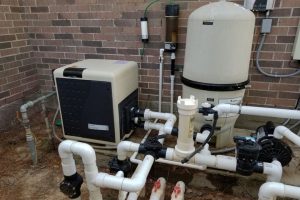
Nevertheless, a saltwater pool is not the same as swimming in the ocean at Pismo Beach; its name comes from the kind of equipment the pool uses to keep its pool water clean and uncontaminated. Instead of adding chlorine to the pool to keep its water chlorinated, you pour in a predetermined amount salt directly into it, stir it up a little and the salt chlorinator is going to then convert it into chlorine.

When you still have the taste of ocean water or images of Catalina Island’s beaches darting through your mind, don’t be concerned. A saltwater pool uses a concentration of salt that is a lot lower than ocean water. Certainly, if you can taste the salt at all, it is going to be mild, nearly saline-like. While ocean water has salt levels of around 35,000 ppm, whereas saltwater pools typically have 3,000-4,000 ppm.

5 Advantages of Saltwater Pools

Now that you have the basics, here are 5 advantages of saltwater pools.

  1. Saltwater pools are more gentle on your body and swimwear

Saltwater pools are more gentle than conventional chlorine pools. If you have ever spent time in a conventionally chlorinated pool, you’ve most likely experienced the red and irritated eyes that typically come along with the enjoyable times. Conventional chlorine pools also add some significant wear and tear on your swimwear. While saltwater swimming pools are more gentle on you, your family and your guests eyes, hair, and swimwear.

  1. There is no sharp chlorine smell

There will be no chlorine smell. Since the chlorine in saltwater pools is created naturally instead of a man-made manner, you will not have the same sharp chlorine smell.

  1. The water is softer

The water is going to be softer. Salt can be utilized as a water softener in your shower in your home, and it has a similar result on your pool’s water. Pool water that is salt-chlorinated is smoother, leaving your skin less dried out than a conventionally chlorinated pool does.

  1. There is no need to store chlorine

No more chlorine storage. The handling and storing of chemicals are dangerous and annoying. Especially when there are younger children or pets in your home, it can be unsafe to store chlorine. Overall, saltwater pools don’t use chlorine in its synthetic form, as the chlorinator is going to convert the salt into chlorine. The exception to this is when your pool’s water balance gets significantly off track. A lot of the time though, the handling and storing of chlorine are not things you are going to be concerned with.

  1. Lower maintenance cost

Decreased chemical maintenance costs. Salt is a lot cheaper to buy than chlorine. Subject to the size of your pool, you could save hundreds of dollars annually in chemical costs with a saltwater system.

Pool Maintenance In Gilbert, AZ

Pool Service Gilbert is a family-owned and operated business that has been serving the valley since 2004. We offer reliable and affordable pool services, including repairs, equipment installations and more! Our service area includes Ahwatukee, Chandler, Gilbert, Mesa, Phoenix and Tempe, Arizona. Contact us right here for your upcoming pool service needs!

More Articles About Pool Care

How To Open A Pool For The Season
Written by webtechs

How To Open A Pool For The Season

How To Open A Pool For The Season

Follow our step-by-step guide to learn how to open your pool for the season.

Step 1. Clean/Store Pool Cover

  • Begin this process by removing the pool cover, then cleaning it and storing it away.
  • Ensure the pool cover is clean when the time comes to open the pool for the season.

Step 2. Fill Up The Pool

  • Fill the pool water level to midway up the tile line and skimmer openings.
  • Add water throughout the next few days to maintain the needed level, if necessary.
  • Inspect the auto-fill to make sure it is working properly.

Step 3. Clean Debris

  • Debris can and will accumulate in the pool area during the off-season.
  • Clean any debris in the area at this time.

Step 4. Inspect/Clean The Pool Filter

  • Start the season with a clean filter.
  • Check the media cartridges and grids to find any cracks or holes.
  • It is recommended to change the sand in your sand filter once every five years.
  • Add new D.E. after backwashing and before filter startup.
  • Make sure all O-rings are properly sealed.
  • Check to see if the filter gauge is in working condition currently.

Step 5. Reinstall Plugs

  • Replace all of the winterizing plugs.
  • Then reinstall all drain plugs for the pump, filter and heater.
  • Teflon tape should be used to prevent filter drips/pump air leaks.

Step 6. Prime Pool Pump And Filter

  • Using a garden hose, add water to the suction lines to eliminate any air in the plumbing lines.
  • Open the filter gauge pressure relief, recording the starting PSI.
  • Check the controller for the correct time, variable speed, hours of operation and flow pumps.
  • Inspect all components for leaks in the equipment area once the filtration system is operational.
  • Open all suction and return lines, utilizing the multi-port valve to clear any visible debris.
  • Prior to cleaning, return the multi-port valve to the filter position.

Step 7. Test/Balance The Water

  • Using a test kit, check if your pool water chemistry is balanced properly.
  • This is a very important step toward maintaining healthy pool water.

Step 8. Shock The Pool Water

  • Using either a chlorine or non-chlorine shock, disinfect the water thoroughly. 
  • Use chlorine to eliminate any algae, if applicable.
  • Before shocking the water, make sure to brush the algae from the pool walls. 

Step 9. Get Pool Cleaning Equipment Ready

  • Ready all pool equipment at this time, including the following items below.
  • Vacuum plate.
  • Skimmer net.
  • Vacuum head/hose.
  • Telescopic pole.
  • Leaf vacuum.
  • Nylon and wire brush.

Step 10. Get Necessary Pool Chemicals

  • Gather the following pool chemicals prior to opening for the season.
  • Algaecide.
  • Soda ash.
  • Sodium bisulfate.
  • Muriatic acid.
  • Sodium bicarbonate.
  • Calcium chloride.

Pool Care In Gilbert, AZ

Pool Service Gilbert is a family-owned and operated business that has been serving the valley since 2004. We offer reliable and affordable pool services, including repairs, replacement, equipment installations and more! Our service area includes Ahwatukee, Chandler, Gilbert, Mesa, Phoenix and Tempe, Arizona. Contact us right here for your upcoming pool service needs! Call us at 480-748-3022 for more information.

How Long To Wait Between Adding Pool Chemicals
Written by webtechs

How Long To Wait Between Adding Pool Chemicals

How Long To Wait Between Adding Pool Chemicals

Try to wait at least 10 minutes between adding chemicals to your pool. This is a sufficient amount of time for the chemicals to mix in the water.

Adding Chemicals To Your Pool

For your family’s safety, it’s very important that the pool is maintained as a bacteria and algae-free environment. To maintain the water, pool chemicals must be added regularly. Now, this may seem like a daunting and time-consuming chore, but it’s quite simple. All you need to know is which chemicals to use, when to apply them and how long to wait between adding chemicals.

The wait time between adding chemicals needs to be at least 10 minutes, as mentioned above. Under normal conditions, you will also be able to swim in the water roughly 10 minutes after all chemicals have been applied. If you turn your pump on high and slowly pour the chemical mix in front of the return, it should be a pretty smooth process. If you turn the pump on low and add chemicals, the process will take a bit longer.

What Are The Main Pool Chemicals?

  • Algaecides
  • Alkalinity Balancers
  • Alkalinity Increaser
  • Calcium Hardness Increaser
  • Chlorine Stabilizer
  • Cyanuric Acid
  • Hardness Balancers
  • pH Balancers
  • Sanitizers
  • Shock

What Not To Do When Adding Pool Chemicals

Avoid these situations when adding chemicals to your pool:

  • Refrain from adding at the same time or mixing chlorine and muriatic acid. This interaction will produce a toxic gas, which is very dangerous to your health.
  • Chlorinating agents like Cal Hypo and Trichlor should not be mixed together under any circumstance. Putting them in the same feeder can cause an explosion.
  • After you add Calcium Hypochlorite, you will need to wait at least 24 hours before adding chemicals. This could alter their pH. Adjusting pH or Total Alkalinity after the addition of Calcium Hypochlorite will cause the calcium to cloud the water temporarily.
  • A good rule of them is to simply NEVER mix pool chemicals with each other.

Pool Care In Gilbert, AZ

Pool Service Gilbert is a family-owned and operated business that has been serving the valley since 2004. We offer reliable and affordable pool services, including repairs, replacement, equipment installations and more! Our service area includes Ahwatukee, Chandler, Gilbert, Mesa, Phoenix and Tempe, Arizona. Contact us right here for your upcoming pool service needs! Call us at 480-748-3022 for more information.

What Is Glass Bead Blasting In Swimming Pools?
Written by webtechs

What Is Glass Bead Blasting?

What Is Glass Bead Blasting In Swimming Pools?

Glass bead blasting is one of the best ways to remove calcium residue and other deposits from your pool. So, how does this cleaning process work?

Glass Bead Blasting For Pools

Simply put, glass bead blasting is a cleaning technique used for pool tiles. This technique is very similar to sand blasting, but glass beads are used instead of sand particles. If this cleaning process is performed by a professional service, any calcium build up will be completely wiped away without causing any damage to the tile. Glass beads are capable of blasting off calcium and other deposits from Pebble Tec, pool stone and other pool surfaces.

The beads are also capable of ridding the surface of algae, which can grow on your pool grout. Typically, the results of glass bead blasting are comparable, if not better than acid washing or using other chemicals. It will cost less to clean up the glass beads than it would be to re-balance the water afterwards.

What Are Glass Beads Made Of?

Glass beads are comprised of a soda-lime-type glass, which is free from silica and lead. The beads are better suited for cleaning pool tiles because they are smoother than an angular media. Producing a bright, clean and silky finish, so many pool owners opt for this type of tile cleaning. Glass beads can also be recycled more than 30 times and are easy to clean up/vacuum after the service. This eco-friendly cleaning is perfect for any damaged or dirty tiles.

Glass Bead Blasting For Pebble Tec

Glass bead blasting is just one of the many ways you can clean and rejuvenate your pool tiles, especially Pebble Tec. One big benefit of this service is it takes far less time to complete than the average pool scrubber or pumice stone cleaning.

Pool Care In Gilbert, AZ

Pool Service Gilbert is a family-owned and operated business that has been serving the valley since 2004. We offer reliable and affordable pool services, including repairs, replacement, equipment installations and more! Our service area includes Ahwatukee, Chandler, Gilbert, Mesa, Phoenix and Tempe, Arizona. Contact us right here for your upcoming pool service needs! Call us at 480-748-3022 for more information.

How Much Does It Cost To Replace A Pool Pump?
Written by webtechs

Pool Pump Replacement Cost 2022

How Much Does It Cost To Replace A Pool Pump?

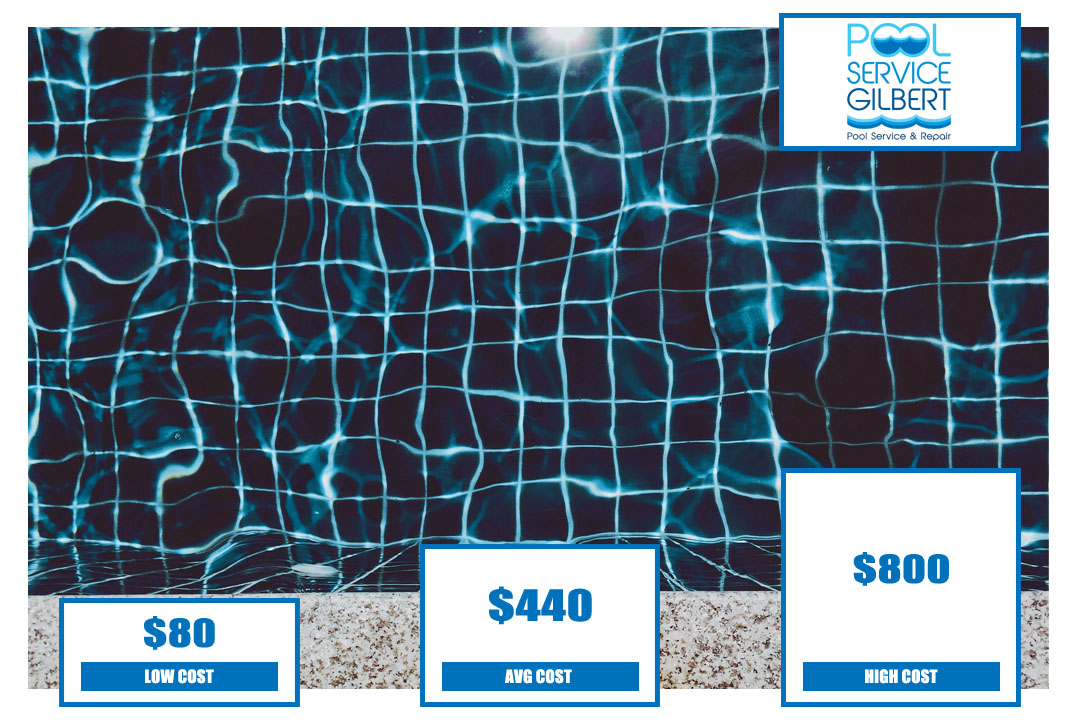
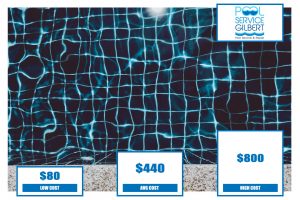
A pool pump replacement costs an average of $440, with prices ranging from $80-$800 in 2022. These price estimates do include the cost of labor, according to improvenet.com. 

Pool Pump Replacement Cost

Owning a pool involves routine maintenance, comprising of repairing the pool liner, repairing the pool heater, and replacing the pool pump. Your pool pump is a vital component of the pool’s filtration system, and as time goes on, they wear out. On average, higher quality pool pumps should be replaced every 8 to twelve years. If you do it yourself it includes the cost of the replacement pool pump, which could run from $150 to $800 or more subject to the kind of pump. When you hire a professional, the cost includes the cost of labor, that is an added $80 to $200.

How Much Does It Cost To Replace A Pool Pump?

Signs You Need To Replace A Pump

There are five obvious signs to look for when it comes to pool pump repairs, listed above. Rumbling noises should be noticed right away. Excessively-vibrating pumps will create sometimes loud and consistent noises. The most common reason for the noise is a pump coming loose or dislodged. Get this issue fixed right away before it becomes a larger problem. The good news for pool owners is this issue won’t require a costly repair.

Grinding sounds can be confused as rumbling at first. But, there is a big difference between these various sounds. Grinding means your pump needs new bearings. Older bearings can lead to motor overheating. Bearings are typically cheap, but replacing them requires opening the pump. This is a task best left to the pool service professionals.

Even a well-maintained and routinely checked pump will wear out over time. These pool pumps can last between 8 to 12 years. However, many pool owners may notice failure at an earlier age. If your pump is getting up their in age, it’s time to start thinking about repairs and/or replacement.

Bubbles in your pool water may seem innocent, but this is not a good sign at all. Bubbles are a clear indication of an air leak in your pump. Dirty water can result from an air leak and can pose numerous health hazards. Have a pool cleaning service check this issue out immediately.

When Is It Time To Replace A Pool Pump?

There are two elements in pool pumps: the pump device and the motor device. Either one could fail and will need your attention. indicators that it’s time to replace your pool pump comprise of:

  • Total motor failure
  • Loud noises coming from the motor
  • The pump isn’t pumping water, or the pump is leaking

Pool-Pump-Repair-Near-Me-Gilbert-AZ

Pool Pump Motor Replacement Cost

If the pool pump is somewhat new (ten years old or less) and the exterior of the pump does not show indications of degradation, just replacing the motor could be a good idea. When the pump has some age to it, and the motor replacement parts are exhausting to track down or when the cost of the motor replacement is higher than 75% of the cost of a total pump replacement, total pump replacement is the route you should take.

If the pump is still under its warranty, then totally replace the pump. Motor replacement is a lot less expensive than replacing the entire pool pump. Replacing the pump yourself costs somewhere between $25 to $200, whereas hiring a professional could cost an additional $40 to $100.

Pool Pump Replacement In Gilbert, AZ

Pool Service Gilbert is a family-owned and operated business that has been serving the valley since 2004. We offer reliable and affordable pool services, including repairs, replacement, equipment installations and more! Our service area includes Ahwatukee, Chandler, Gilbert, Mesa, Phoenix and Tempe, Arizona. Contact us right here for your upcoming pool service needs! Call us at 480-748-3022 for more information.

How To Replace A Pool Pump
Written by webtechs

How To Replace A Pool Pump

How To Level Ground For Pool Without Digging

Are you planning on replacing a pool pump for your latest DIY project? Follow our five steps below!

Step 1. Turn Off Power

Disconnecting the pump from the power source is the first step to take when replacing the pump. The safest way to do this is by simply switching the appropriate circuit breaker to the OFF position. After power is turned off, test the pool pump just to make sure it is, indeed, off.

Step 2. Disconnect/Remove Pump

Once the power is turned off, remove the motor cover, then disconnect all electrical wiring to the pump. Disconnect all plumbing connections to the old pump next. Use an adjustable wrench to make this part of the process easier. Ensure that you do not damage any of these parts, as they will be used for the replacement pump. Once you have disconnected the old pump, remove it from the area entirely.

Step 3. Connect The New Pump

After removing the cover of the motor, connect all electrical wires to the new pump. After all parts are connected, you can turn on the new pump to make sure it’s working properly.

Step 4. Turn Power On

To start, make sure the power switch on the pump is in the OFF position. Then, turn the appropriate circuit breaker to the ON position.

Step 5. Prime The New Pump

Fill the new pump up with water, ensuring the pump trap is full. Watch to make sure the water moves through the suction lines of the pump once the pump is flipped on. Then, open the inlet shutoff valves until water circulates throughout the entire pump. Your new pump is now ready for use!

How Much Does It Cost To Replace A Pool Pump?

Owning a pool involves routine maintenance, comprising of repairing the pool liner, repairing the pool heater, and replacing the pool pump. Your pool pump is a vital component of the pool’s filtration system, and as time goes on, they wear out. On average, higher quality pool pumps should be replaced every 8 to twelve years.

If you do it yourself it includes the cost of the replacement pool pump, which could run from $150 to $800 or more subject to the kind of pump. When you hire a professional, the cost includes the cost of labor, that is an added $80 to $200.

Pool Maintenance In Gilbert, AZ

Pool Service Gilbert is a family-owned and operated business that has been serving the valley since 2004. We offer reliable and affordable pool services, including repairs, equipment installations and more! Our service area includes Ahwatukee, Chandler, Gilbert, Mesa, Phoenix and Tempe, Arizona. Contact us right here for your upcoming pool service needs!

More Articles About Pool Care

sump pump failure
Written by webtechs

Sump Pump Failure

sump pump failure

If you are searching for “sump pump failure“, Pool Service Gilbert is here to help you troubleshoot the problem! Below are five warning signs that your sump pump is failing and when a replacement is necessary.

Signs You May Have Sump Pump Failure

These five warning signs are going to let you know it’s time to replace your sump pump:

  1. Sump pump will not shut off
  2. Sump pump easily clogs
  3. Irregular cycling
  4. Wear and tear
  5. Constant noise

Sump Pump Will Not Shut Off

Regardless of weather conditions, when your pump is continuously running it is a clear sign that something is off with the pump. Unreasonable strain is placed on the pump’s motor when the pump continues to run even after all of the water is emptied out the basin. Water assists in cooling the pump down, so when it continues to run without water, it is going to overheat quickly. When the issue remains, it can cause untimely failure of the pump. Continual running can be caused by a assortment of causes, including wrong pump size or a stuck float switch in the on position, among others.

Sump Pump Clogs

Taking on the source of incoming debris is the best way to protect the pump from clogging. Try securing your basin using an airtight lid to hinder any leaves, sticks or even small animals from falling down into the pump’s pit area. When water is delivered to the pump via downspout, is it suggested to install a screen to prevent anything from getting into the basin and damaging the pit. When you must get bacterial iron out of the water supply, you might have to shock chlorinate your well water.

Erratic Cycling

Whenever a pump is cycling intermittently or taking longer than usual to empty the water from its basin, it might be time to have the pump inspected via a professional. Any type of continual bursts of activity usually indicates a check valve failure. Typically, loose wiring is the culprit when erratic cycling happens. If the pump suddenly shuts off, turn off its power source, then disconnect it. Check the area to be sure there aren’t any visible loose wires.

Wear And Tear

Whereas common sense indicates an older sump pump is more possible to fail than a new one, a lot of pool owners wait way too long to actually replace it. It is very easy to overlook how long you have had the sump pump when it’s never created problems for you. Don’t make the mistake of postponing routine maintenance inspections. Regardless of how well it operates, when the pump is approaching ten years plus, it’s suggested to replace the pump before it fails. A replacement is a lot less costly than having to deal with any type of water damage.

Constant Noise

An unusually noisy motor is a clear indication that the motor is coming to it end. If you happen to have an older plastic pump, then it’s time to update your system. These newer pumps are a lot more reliable and require less maintenance to keep them running. Newer cast-iron pumps are also less probable to overheat. With the new pump, it is possible for replacing the failing motor without buying a replacement pump. Pedestal sump pumps have motors that sit above the basin, making a motor replacement a very easy process.

Pool Service In Gilbert, AZ

Pool Service Gilbert is a family-owned and operated business that has been serving the valley since 2004. We offer reliable and affordable pool services, including repairs, replacement, equipment installations and more! Our service area includes Ahwatukee, Chandler, Gilbert, Mesa, Phoenix and Tempe, Arizona. Contact us right here for your upcoming pool service needs! Call us at 480-748-3022 for more information.

Pool Light Replacement Cost
Written by webtechs

How Much Does Pool Light Replacement Cost ?

How Much Does It Cost To Replace A Pool Pump?
The average pool light replacement cost $625. Pool light repairs prices are a lot more budget friendly at $65 to $150 each. Simply replacing the bulbs is $20 to $100 for each one subject to type and function. Colorful LED bulbs are most costly but last longer than other types of bulbs. If you’re thinking about getting an inground pool, you are most likely also considering installing underwater pool lighting. Because we work with a lot of homeowners throughout Gilbert, Arizona and surrounding areas each year, we have the chance to answer a lot of questions concerning pool lighting. In this post, it is going to cover some common inground pool lighting questions that we receive day to day.

What should I know about pool lights?

Lighting your pool allows you to swim at nighttime with single or multi-colored ambient light. LED pool lighting enables you to change colors with ease, possibly with your smart phone. In-pool lighting is required to be installed during the pools construction. Small LED lights cost around $700–$900 installed, and fiber optics cost about $1,300–$1,700. The only necessary maintenance is bulb replacement.

 Why should I light my pool?

First and foremost, lighting your pool is going to allow you to fully take advantage of your pool throughout day and night. A lot of people find nighttime swimming soothing and relaxing, but it’s just not the same without the ambiance of reflective light that underwater lights provide. Lighting your inground pool also gives homeowners peace of mind when overseeing children swim at night because adds improved visibility throughout the whole pool.

 Are pool lights required to be installed during construction, or can I add them later?

Many pool accessories can be added at a later date, but pool lights don’t offer that versatility…not without significant renovation work. It is recommended if you’re in the slightest considering light your pool, it’s best to have it installed during the pool’s construction.

 How many lights am I going to need?

It subject to the type of light, it is suggested that one light, at the minimum, is going to adequately light up a pool up to thirty foot long. Pools longer than thirty feet are going to require two lights. Take heed that this is the smallest amount, most people end up getting two lights installed, and some even require to install three lights on larger pools. As of this post, full sized LED pool lights, like those that are usually installed in vinyl lined or concrete pools, typically cost between $1,000 and $1,500 installed.

  • Smaller LED lights usually cost between $700 and $900 installed.
  • Fiber optic pool lighting is typically around $1,300 to $1,700 installed.
  • Full sized incandescent pool lighting is usually around $450 to $650.

 What is the required maintenance?

The only maintenance required for any pool light is replacing the bulb. Regardless of the kind of light, you should never have the need to lower the pool’s water level for replacing the bulb. In many cases, it is simply loosening a single screw, pulling the bulb housing out of the water and replacing the bulb. The replacing only takes 5 to 10 minutes. Other types of lights, nevertheless, require that the entire housing be replaced, in which takes more time but still not a huge undertaking, especially bearing in mind the average bulb lasts for years and years. Replacing fiber optic bulbs is very easy as you just remove the box cover, located on or close to the patio, and put in a new bulb. Bulb replacement prices at the time of this post are as follows:

  • Larger LED $450 to $650
  • Smaller LED $50 to $350 subject to the model
  • Fiber optics $20 to $60
  • Incandescents $30 to $70

 Are pool lights safe?

Short answer, absolutely, they are extremely safe, so long as they are installed in accordance to manufacturer’s specifications and local building code compliant. Today’s pool lights, correctly installed, are basically risk free.

Pool Light Replacement In Gilbert, AZ

Pool Service Gilbert is a family-owned and operated business that has been serving the valley since 2004. We offer reliable and affordable pool services, including repairs, replacement, equipment installations and more! Our service area includes Ahwatukee, Chandler, Gilbert, Mesa, Phoenix and Tempe, Arizona. Contact us right here for your upcoming pool service needs! Call us at 480-748-3022 for more information.

Written by webtechs

5 Common Pool Problems

5 Common Pool Problems

When you are searching for common pool problems and how to fix them when they come up arise, Pool Service Gilbert is here to help! Keep read to find out more about 5 common pool problems and how to fix them.

Algae Growth

A pool in good health should appear as a clear or bluish tone. Yet, we have all noticed pools that appear cloudy and green over time. A pool that turns green has usually been overtaken with hazardous algae. This is one the more common pool problems that homeowners are going to encounter. Typically, algae are going to affect pools with a chlorine level that is lower than recommended.

The Prevention of Algae Growth

  • Call an experienced pool service when you’re not comfortable taking on this task.
  • Following the algae being eliminated, increase the pools chlorine levels.
  • Keep adding chlorine to hinder future algae growth.

Clogged Pool Filters

Your pool circulates its water, and with the circulation it could eventually be disrupted when the pool filter becomes clogged. This can happen if a pool isn’t being regularly maintained. Debris such as dirt, insects and leaves can clog the filter, making it become ineffective. Examine the filter when you happen to see more debris than you typically see in your pool.

Fixing A Clogged Pool Filter

  • Clear out the pool filter and pool.
  • Regularly clear debris from the area to hinder future problems.

Low Or High pH

Safe pH levels for swimming pool water are between 7.2 and 7.6. Any level that is below or above this those can cause irritated eyes, throat, and skin. You can find out your pH level in your pool by testing it regularly. Balance the pH using pool chemicals, when required.

How To Fix pH Levels

  • Regularly test you pools pH level.
  • Balance the pH level with the addition of pool chemicals.

Overabundance of Chlorine

Whereas chlorine is needed to hinder the growth of algae, an overabundance of chlorine can be almost as hazardous as algae. Signs of an overabundance chlorine is going to include having a hard time seeing underwater and/or severe eye irritation.

How To Remedy Chlorine Levels

  • Continually measure your pools chlorine levels using test strips, kits, or readers.

Cloudy Water

Every homeowner wants their pool to be crystal clear, but some notice a blanket of haze is hovering above the pool water. The most common reason for this is probably a bacteria build-up in the pool water. Be sure to test your chlorine levels in these cases. When your chlorine levels are low, bacteria are not going to be eliminated effectively.

How To Fix Cloudy Pool Water

  • Regularly test your pools chlorine levels.
  • Add chemicals, when required.

Pool Pump Replacement In Gilbert, AZ

Pool Service Gilbert is a family-owned and operated business that has been serving the valley since 2004. We offer reliable and affordable pool services, including repairs, replacement, equipment installations and more! Our service area includes Ahwatukee, Chandler, Gilbert, Mesa, Phoenix and Tempe, Arizona. Contact us right here for your upcoming pool service needs! Call us at 480-748-3022 for more information.

Salt Water Pool Maintenance Checklist
Written by webtechs

Salt Water Pool Maintenance Checklist

Salt Water Pool Maintenance Checklist
If you are looking for a maintenance checklist for your salt water pool, Pool Service Gilbert is here to help!

Weekly Maintenance

All pool owners should make it a habit to clean the pool and its filters as often as possible. Performing these simple tasks can save you time and money in the long run. A cleaning of a slat water pool needs to also include the skimmer. Empty the pump basket and skim for any noticeable debris in the area.

Testing the pool’s pH and free chlorine should be a weekly task. If the chlorine level is a bit off, adjust your generator. Baking soda, sodium carbonate or muriatic acid can be used to raise the pH level.

Weekly Maintenance Checklist:

  • Check the water for clarity/color change.
  • Remove any debris from the pool area.
  • Empty skimmer and pump strainer baskets.
  • Vacuum pool or run pool cleaner.
  • Check filter pressure and backwash.
  • Check water level.
  • Test the salt concentration level.
  • Test the free chlorine level.
  • Test the pH level, adjust if necessary.

Monthly Maintenance

Here are the four things that should be checked every month: calcium, stabilizer, salinity and alkalinity. Check your owner’s manual to see exactly where all the levels should be. Once again, baking soda can be applied to help raise the alkalinity level.

Make sure to open and inspect the salt water cell. The experts recommend doing this every three months. You’ll want to visually inspect the pool for scale and deposit buildups, as well.

Monthly Maintenance Checklist:

  • Test the Total Alkalinity (TA).
  • Test the Stabilizer or Cyanuric Acid level.
  • Test the Total Dissolved Solids level.
  • Test the Calcium Hardness level.
  • Test to see if hard materials are present, such as copper or iron.

Yearly Maintenance

Yearly maintenance can change depending on location. In Gilbert, Arizona for example, pool owners will never have to winterize or close the swimming area. In other parts of the country, though, it is recommended to read the owner’s manual for instructions on opening and closing the pool.

Yearly Maintenance Checklist:

  • Perform proper closing or winterizing steps, if needed.
  • Clean the salt cell and store inside.
  • Perform proper opening steps in the spring.

Pool Maintenance In Gilbert, AZ

Pool Service Gilbert is a family-owned and operated business that has been serving the valley since 2004. We offer reliable and affordable pool services, including repairs, equipment installations and more! Our service area includes Ahwatukee, Chandler, Gilbert, Mesa, Phoenix and Tempe, Arizona. Contact us right here for your upcoming pool service needs!

More Articles About Pool Care

1 5 6 7 8 9